Isometric Exercises - Isometrics | Isometric Training Tips & Workouts
Watch This Free Video Before Anything Else !

What are Isometric Exercises and How can they help Build strength?
Isometrics or isometric exercises have a long history starting from the Charles Atlas dynamic tension techniques for building muscle and strength.
When combined with weight training and bodyweight exercises, isometrics can help you build incredible strength and power.
Isometric Exercises, also called Isometrics are a great way to Build Strength, power, rehabilitation and a sculpted physique. Isometric Exercise Examples, Workouts and Training Tips.
Inside the Isometric Exercises Section
- Definition of Isometric Exercises
- Advantages of Isometrics
- Top Isometric Training Tips
- Best Isometric Exercises
- Conclusion
- Related Articles - Functional Isometrics and Isokinetic Exercises.
P.S. - Isometric Contractions do cause an abrupt rise in Blood Pressure. Please consult a physician before you start such a program.
Definition of Isometrics
Visit Animal Kingdom Workout for more cool information.
Isometrics are derived from Greek words - Isos { equal} + Metrikos { meaning measurement }.
Isometrics are defined as a type of muscle contractions wherein the muscle develops tension without changing length.
In the language of Exercise Science tension in the cross-bridges equals the resistance to shortening and the muscle length remains relatively constant.
Example - The simplest example is pushing against the wall. Although force is being generated and the muscles are contracting there is no change in their length {or the movement of the wall! }
Also when you do sit-ups exercise, your trunk muscles are isometrically contracting to maintain the rigidity of the trunk and stabilize it so that hip-flexors perform the movement.
Advantages of Isometrics
- Isometric Exercises help Build Muscle, Strength and Power.
- The tension developed during isometric exercises is often higher than that developed during Isotonic Contractions.
- Since they do not use any equipment, Isometrics can be performed anywhere, anytime. All you need is a fixed, stationery object for these exercises.
The biggest drawback in case of Isometrics is that they are not functional in nature and activities like sports may not see readily transferable skill or power development. Also is it impossible to build a muscular, bodybuilder-like physique with Isometrics alone.
Important Isometric Training Tips
- Mind is the most important tool for Isometric training, more than other forms of training since force generation depends only on YOU.
- The duration of Isometric Contraction depends on the intensity of contraction with the best duration being between 1 to 5 minutes and peak contraction held for 2-5 seconds.
- Perform each exercise at least 3-10 times for any noticeable result. Although research has shown that a single-set is enough, performing multiple sets will give a added effect and exhaust your muscle completely.
- Functional Isometrics - This type of Isometric Training involved use of Weight Training Equipments and is dealt in the Functional Isometric Training Section.
Isometric Exercises
Here are a few Isometric Exercises which I have found to be the best ones.
Please perform the stretches mentioned in the Stretching Exercises section before any Isometric Exercise session.
Although Isometric Exercises can be done for any and all muscles I will restrict myself to the best exercises for major muscle groups.
Exercise One - Shoulder Muscle Contraction
Steps
- I suggest that you do this exercise in the standing position.
- For right deltoid contraction exercise, clench your right fist firmly { palm facing inwards } while your left hand holds the right wrist in front of your body.
- At this point push your right hand upwards while resisting it with your left hand.
- Hold the contraction for the stated period.
- Repeat on the other side in the exact manner.
Exercise Two - Biceps - The Curl
- I suggest that you do this exercise in the standing position.
- Give a biceps pose with your right arm bent at the elbows.
- Now place your left hand over your right wrist while contracting your biceps as hard as possible and maintaining your hardest contraction for at least 5 seconds.
- Repeat on the other side in the exact manner.
Exercise Three - Isometric Squats Exercise
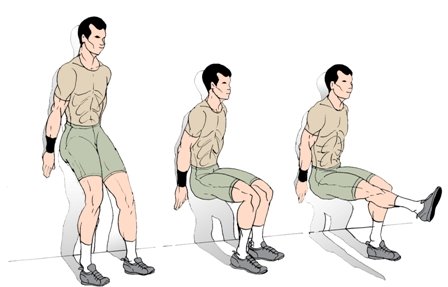
Functional Isometrics
In Exercise Physiology there is a concept of specificity wherein when you train at specific joint angles, you build significant strength at the same angle and by training with isometric contractions at the sticking points, you can increase strength at these critical and limiting angles, thereby improving your overall strength in that particular exercise.
Here is how to do it.
You can either use a machine with pins to block the barbell movement at a particular angel or make use of a spotter.
The exercise - Lets select an exercise like barbell Curls for Biceps. The sticking point here is at a joint angle when the forearm is parallel to the floor. By placing pins in a power rack at this point you can perform an isometric contraction.
By contracting at the sticking point you improve on the sticking part { the most difficult part of the exercise } and thereby remove the limiting factor and improve overall lift as discussed earlier.
I personally use the principle of Burn at the end of my last set wherein I just hold the weight, now barely movable by my own strength for as long as I can so that my muscles contract to their full capacity.
Conclusion
Isometric Exercises are great to build strength and as for rehab but make sure they are only one part of your overall training arsenal.
Also read
- Isokinetic Training - Isokinetic Exercises - Isokinetics - Coming Soon.
- Bodyweight Exercises
- Workout without Weights.
- What is Isometric Exercise
- Isometrics for Gymnasts
Common Visitors asked Isometric Exercise Questions and Answers - FAQs
1. Any examples of isometric exercises, list of isometric exercises?
Isometric exercises come in all forms. Basically, any exercises performed with enhanced static contractions can be considered an effective isometric exercise. Among the most common and simplest exercises would be to press your hands against a wall and hold for a few seconds. Another common exercise to perform would be to hold you hands in front of your chest and place the fist into the palm and hold it. Performing bodyweight exercises and light weight barbell exercises in a slow manner would be other excellent exercises to employ.
2. Any isometric bungee exercises?
Performing bungee curls very slowly on the way up and slowly on the way down could be considered excellent bungee exercises. Holding the bungee cords over head in a military press position for ten seconds could be considered a very basic and easy to perform isometric exercise.
3. Any isometric exercises on the plank?
Holding a forward plank situp position with your feet placed on the ball would be the first proper position to hold. A reverse plank position where you would rest the back of your shoulders on the stability ball would be another.
4. What isometric exercises can be done at home?
Any bodyweight or light dumbbell isometric exercise can be performed in the home. The classic Charles Atlas concept of isometric exercises could all be performed easily in the home as they require no equipment whatsoever.
5. Any isometric exercises for arms and chest examples?
The sheer list of exercises that develop isometric strength in the arms and chest would impossible to provide. Here is one example: perform all the bodybuilding posing routines designed to show off the muscles in the arm and the chest. Hold these positions statically for a set number of seconds. This will enhance isometric strength levels.
6. Suggest isometric leg exercises?
Isolation exercises such as leg extensions on a machine performed in a slow manner would be a wise plan. You could also load up so much weight you cannot move the device at all but hold your legs in a dynamic tension position for several seconds instead.
7. Any abdominal isometrics?
Scores of them! They all involves holding tension in the abs. The most basic of these would be to lie on the floor on the flat of your back and "sucking in your gut" and holding the position for a few seconds. A more difficult version of this would be to hold a crunch for a similar duration.
8. Any isometric hand exerciser?
Yes, the traditional grip spring exerciser and a gripping ball can help you arrive at such an outcome. As with other isometric exercises, you simply need to hold the grip as the tension builds for a few seconds.
9. How to jump higher isometric exercises?
Generally, anything that supports the muscles of the legs can provide a boost for jumping strength. Use a calf machine to perform static contraction exercises for 10 second reps would be a perfect example of this.
10. Is isometric weight loss possible?
Although isometrics are not considered fat burning exercises by any stretch of the imagination, they do build up the muscles. The enhancement of the muscles will lead to the metabolism speeding up which will support weight loss potential.
11. How to do pushups with isometric?
The best way to perform isometric pushups would be to stop at some point and remain static for 10 seconds of more. Another way to enhance isometric strength with pushups would be to perform the pushups in a very slow manner.
12. Any hip isometrics or butt isometric exercises?
There are several and one of the best would be to perform static leg presses. This would hit both the hip and butt. Isometric hip flexor exercises would, of course, hit the hips more directly. The same could be said of hip extension exercises.
13. What are the isometric exercises for speed conditioning?
There are quite a few exercises that enhance the legs and the lower body so as to boost speed conditioning. Among the best would be the wall sit which is also known as the Hercules chair. Other top exercises would be the leg raise, the split squat, and the hip extension.
14. Any isometric stretching?
Yes, but this is a very advanced form of stretching. Basically, any time a static contraction is performed with a stretch while simultaneously not expanding the length of the stretch, helpful isometric stretching is undertaken.
15. How to do isometric strength training and use isometrics for strength?
Strength is a byproduct of any type of isometric training. When you perform isometric exercises, you enhance you ability to maintain strength in static positions. This also aids in expanding the endurance levels of the muscles. Both of these components certainly open the door to becoming a much stronger individual.
16. What isometric workouts can I do in 10 or 15 minutes?
A morning stretching routine that works the upper body but done in a manner that promotes continuous tension would be a good program. Follow this up with squats and ab exercises performed with an acceptable level of dynamic tension. Ten minutes per day of such exercises will lead to great benefits in the long run.
17. Isometrics vs. weightlifting. Also can gymnasts use isometric exercises?
Isometrics is designed to expand strength in both static positions and in deliberate movement. It is also intended to enhance muscular endurance. Weightlifting is about lifting heavy weights either for powerlifting or bodybuilding. The focus is completely different from isometric training.
Check out Isometric Training Exercises for Gymnastics here.
18. What are the best isometric exercises for bike riding cycling?
Any isometric leg exercise will be a help. Also, you could get on a stationary bike and hold the handles with dynamic tension. The same process could be applied to the position of pushing one peddle down and pulling on the one that is in the up position.
19. Suggest any free isometric routines?
There are a few: performing all modes of exercises on a stability ball; performing body weight exercises with dynamic tension; performing contractions with your hands on the wheel of a car when stuck in traffic; grabbing your desk at work and contracting the grip; etc. You can perform all manner of routines without any equipment or cost.
20. How to do hamstring isometrics or hamstring isometric exercises?
Static leg presses would be among the best to do this. Holding a Swiss ball with your feet and lying on the ground and curling in the ball would hit the hamstring effectively. And isometric hamstring bend performed in a controlled manner is another methodology to perform.
21. How to do isometric speed training workouts work?
They are designed to enhance the muscles of the lower body (hip, legs, butt, calves, etc) through static contraction and dynamic tension. This boosts the lower body's strength making it capable of performing speed based movements.
22.Is strenuous isometric exercise adequate physical activity?
Strenuous activities are generally not recommended whether isometric or not. While it is possible to up the intensity level of an isometric workout, it probably would not be a wise plan to turn the workout into a strenuous one. Stick with those exercise programs that are of moderate intensity level and perform them regularly.
Go Back to Top of Isometric Exercises Page.